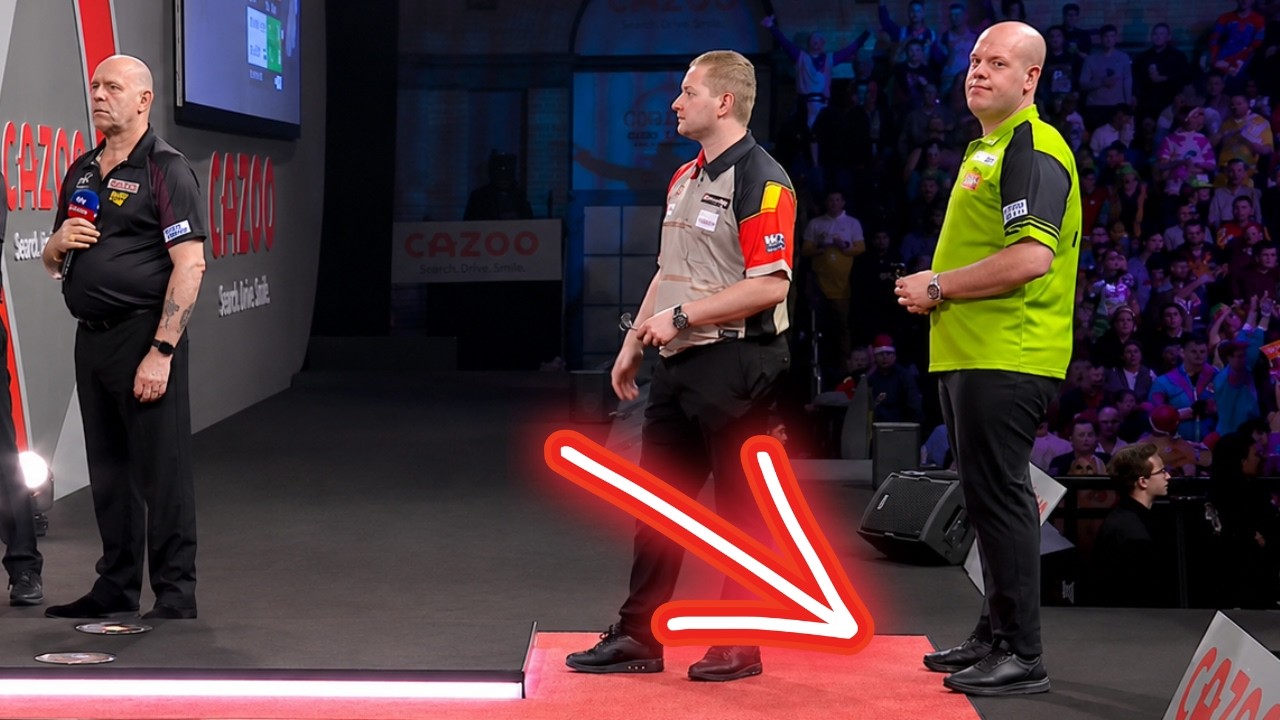
For more than ten years, opponents of Michael van Gerwen have walked off stage angrier than the scoreline should have made them. A German broadcaster used the word overstep. A future world champion accused him of coughing during his throw. A Premier League final referee had to intervene on stage. Named complaints have come from Adrian Lewis, Luke Humphries, Jonny Clayton, and Dimitri van den Bergh — players who have themselves won or contended for world titles. No public PDC sanction has ever followed any of it.
This is the reason nothing has been done. The PDC rulebook does not define an exclusive zone around the ockey in feet or centimetres. The rule about what the non-throwing player is supposed to do is written as a convention rather than a hard line, which means a referee in real time has nothing precise to point at. Grey areas reward the player willing to live inside them, and Van Gerwen has been willing for a decade.
The case for the defence is not a weak one. His natural body language is leaning, animated, and forward-set. Many great players have stood close behind the thrower, Phil Taylor included. No sanction has been issued, which his defenders argue is itself the evidence. The case for the prosecution rests on the pattern — the same complaints, from elite-level players, across the same ten years, with a major European sports broadcaster framing a World Championship semi-final as a crossing of a line.
No new rule has been introduced. The trick, if it is a trick, is still working.
RIGHT NOTICE: The Copyright Laws of the United States recognize a “fair use” of copyrighted content. Section 107 of the U.S. Copyright Act states: “Notwithstanding the provisions of sections 106 and 106A, the fair use of a copyrighted work, including such use by reproduction in copies or phonorecords or by any other means specified by that section, for purposes such as criticism, comment, news reporting, teaching (including multiple copies for classroom use), scholarship, or research, is not an infringement of copyright.” This video and our YouTube channel, in general, may contain certain copyrighted works that were not specifically authorized to be used by the copyright holder(s), but which we believe in good faith are protected by federal law and the fair use doctrine for one or more of the reasons noted above. Fair Dealing: Copyright, Designs and Patent Act 1988 (UK) section 30 states “Fair dealing” with a work for the purposes of criticism or review, of that or another work, does not infringe any copyright in the work provided that it is accompanied by a sufficient acknowledgement. Copyright in a work is not infringed by the use of a quotation from the work (whether for criticism or review or otherwise).———————————————————————————————————————–
Contact:
[amazon_auto_links id="551"]